Blog Directory - Blogged

Thursday, October 22, 2009

Your Guide to Enterprise Content Management Systems

enterprise content management Every company has wide variety of data that it needs to manage. While for some it is easy to take care of the information stored in their machines by taking a backup every night, others need more expert solutions, especially the organizations spread over different cities, countries and continents.

ECM or enterprise content management combines a wide variety of components and technologies to deliver robust solutions. Some of these components are used as stand-alone systems and are not required to be incorporated into an enterprise-wide system.

ECM helps content management systems of organizations manage, control, utilize and share important information and optimises the business processes. A good enterprise content management system integrates with the organization’s applications and enhances the durability of content delivered to users, whether internal or external. It also ensures that the risks are minimized and also eliminates the redundancy very effectively.


What to keep in mind when building the ECM for your company?

Since the cost of installing an ECM system can be too much, it is very essential that organizations select the enterprise content management system which fits their needs and budget in the most suitable way. Spending too much on ECM initially can be a grave mistake as it requires a constant update and if a hefty amount is spent in the beginning only then the upgrades will require more financial resources. The best way to keep away from overspending is to create a list of requirements before installing the system.

What are the Requirements of a Good ECM?

Content creators are the vital users of the enterprise content management system. Therefore all the areas within the system must be analyzed carefully to see and notice the effects they will have on the work done by the content creators. These content creators have to have the complete access of the system and some have to be given advanced users rights as well, depending on the seniority of the person.



Saturday, October 10, 2009

What Can Enterprise Content Management Do For Your Company?

ecm

ECM refers to the strategies, technologies, methods and tools used to capture manage, store, preserve and deliver content. Enterprise content management tools allow management to be at an enterprise level of organization.

ECM has moved away from the old ways of finding-and-filing to a technology that not only manages information, but processes it as well. Enterprise content management can manage information without regard to its source or use.

Many organizations hesitate to implement enterprise content management solutions because of the problems of implementing best practices and standardizing operations enterprise-wide. Each department, each regional office and each workgroup has its own ways of doing business, and they often fear it will force them to change the way they work. Information ends up in multiple locations, with no way for the central office to sort it all out. And the system ends up compounding the problems it was supposed to solve.

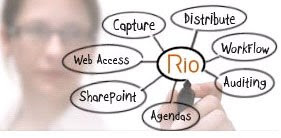
The Laserfiche Rio ECM system is different and fits with existing business processes into an enterprise framework. It gives organizations control and flexibility.

Thursday, September 17, 2009

Where are the Little Efficiencies?

ECM

ECM: The budget crunch is upon all of us, and, as a result, we’re all looking at where the little efficiencies are to stretch our existing dollars as far as possible. With Laserfiche ECM there are many aspects to consider when making decisions.

Repositories and licenses cost money. So does scanning. How can we best use our existing resources?

Change your repository settings!

Changing your repository options, specifically the ‘logout automatically’ option, will prevent your users from becoming license hogs. That person who logs in and then leaves for lunch will be logged off automatically, freeing up a license for another user.

In Hampton, we’ve adopted a 1:5 user license ratio for both FX and RX licenses. Due to the fact that licenses are concurrent, we believe that it’s reasonable to expect that any user, particularly retrieve or read-only users, will access enterprise content management, find what they need and then exit the system.

What kind of scanning devices do you have available?

While scanners are “the” option when it comes to high quantity document capture, almost all types of copy machines have scanning capability and can easily scan to e-mail. Ask your IT Department or manufacturer representative to set the image to either tiff or pdf and add all users to the email setting.

Even if all of your office staff are not enterprise content management users, being able to copy/scan to e-mail prevents the proliferation of paper, which could be another significant cost savings for you.

Do all of your users know, enterprise content management and understand how to use Laserfiche’s e-mail utility?

This again will decrease the proliferation of paper in your office and to your clients or the public.

Are you fully utilizing your LSAP?

Your time is valuable to your employer and we all pay for software support. When you have questions, contact your reseller and employ their assistance with answers and best practices. You don’t have to figure it out on your own.

What’s in ECM?

If Laserfiche has become the new dumping ground (in addition to your network, pc’s, and ancillary devices…) then your data – and your server – could use some basic management.

  1. Purge your data; set up your Records Management Edition if you have it – practice good records management!
  2. Check your folder structure.
  3. Manage your volumes.
  4. Use your Column Display wisely.

Friday, September 11, 2009

BOOST YOUR BUSINESS WITH ENTERPRISE CONTENT MANAGEMENT

ecm

Enterprise Content Management (ECM) consists of the strategies and methods used to manage and interpret documents related to work in an organization.

In today’s information age, the success and failure of an enterprise is dictated primarily by two factors – the rate of influx of data into an enterprise database and the constant interpreting and evaluation of this data into logical information as input for strategic planning.

As unstructured content is checked in and out of a system, each use can potentially add to the content's profile. With time, the ECM system might gradually adopt new filtering, which assists in making better decisions, determining the relevance of information and documents.

For example, in order to improve efficiency while still adhering to Federal Laws and guidelines, an eminent South Western US University turned to implement Enterprise Content Management. The university used ECM to bring business processes together and accelerate information exchange. This solution not only helped the university to ensure efficient administration, it also minimized the impact on staff—improving productivity and reducing costs.

According to the Association for Information and Image Management (AIIM), Enterprise Content Management can be broken down into five major components:

  • Capture: Obtain and organize information.
  • Manage: Process and employ information as per requirement.
  • Store: Temporary back up of transient information.
  • Preserve: More permanent storage of unchanging data.
  • Deliver: Provide clients and end users with requested data and analyses.

While identifying a direct return on investment can be difficult, it is possible to see the impacts of the improved process efficiency. With the enforced usage of these tools within the organization, they become part of the work culture. What's the ROI on a fax-machine? Virtually negligible, per se. However, who can imagine running an organization without one?

It's not enough to simply maintain and hold extensive database information. Content must be managed so that it can be used to achieve business goals, which is the goal behind implementation of Enterprise Content Management.

Tuesday, September 1, 2009

News from the Central VA Laserfiche User Group

In Central Virginia, ECM is moving right along! In fact, the Central Virginia Regional Enterprise content management system company Laserfiche User Group, is meeting at the Albemarle County Office Building. This meeting will feature speakers from the Library of Virginia, who will give a presentation and field questions about ECM records for local governments and state agencies.

enterprise content management

Training will cover electronic records, both scanned documents as well as other enterprise content management stored records (such as databases, Word files, Excel, etc). Retention and destruction requirements and using the retention schedules will all be included as well.

One of our members, Corey Smith, from the Library of Virginia, has provided some information that provides excellent background and will help everyone attending come prepared with specific, pertinent questions.

Corey says:

“As your primary interest is with electronic records that are scanned and in a database, I would like to mention that records follow the same retention period regardless of format. Caveats come into play as retention periods differ and some records may not be the best candidate for a particular format. For example, a record with a 50 yr retention would not be recommended to kept on a CD. The life expectancy of a CD is only 20 yrs. Because of this, anything with a permanent retention or with a long retention would not be recommended for a CD format.

“On the LVA Website, you can access our updated Electronic Records Guidelines that can hopefully provide some additional information for your benefit.

“To give you an idea of what’s considered personal identifying information, under section “C” of 18.2-186.3 in the Code of Virginia, it defines certain types of personal identifying information.”

If you’re in the Central Virginia area, we hope to see you at our User Group meeting!

Our Agenda:

  • Welcome/introductions
  • Group business & info
  • Lightning Talks (Mini-Success Stories) – each person has up to 3 minutes to talk about something cool they learned or did with Laserfiche recently
  • Library of Virginia presentation, followed by questions from attendees

Tuesday, August 4, 2009

Flexible Enterprise Content Management Solutions for Your Industry

Many organizations hesitate to implement ECM solutions because of the problems of implementing best practices and standardizing operations enterprise-wide. Each department, each regional office and each workgroup has its own ways of doing business, and they often fear it will force them to change the way they work. Information ends up in multiple locations, with no way for the central office to sort it all out. And the system ends up compounding the problems it was supposed to solve.

The Rio ECM system is different because it fits existing business processes into an enterprise framework. It gives people the control they need and the flexibility they want. Enterprise content management organically expands throughout organizations, regardless of the industry:

· State and Local Government

· Federal Government:

· Financial Services

· Health Care:

Enterprise content management offers organizations the strength of a proven information management system and the technology of a highly sophisticated business process management engine.


Tuesday, July 21, 2009

Enterprise Content Management System

According to AIIM (Association for Information and Image Management) International, Enterprise Content Management or ECM is the collection of methods, strategies, and tools that are used to manage, capture, preserve or store, and deliver content matter and documents related to organizational processes. In other words,

ECM

content management suite is a computer application that lets you create, edit, publish or manipulate the content of a website.


It is generally used for the purpose of storing and retrieval of user manuals, news articles, brochures, guides and other technical data. The content can be in any form: audio, video, visual, text, spreadsheet, excel, word documents etc. The basic types of Content Management Suites include: Web, Enterprise and Component systems.

So if you are looking to introduce your business to the audience on World Wide Web, or perhaps have an existing website and feel that there is a need to update its looks, a content management suite can help you in achieving your target.

Prerequisites of a good Enterprise Content Management :

Content creators are the most important users of an enterprise management system. Everything within the system has to be analyzed cautiously to see different kind of effects they have on the work done by the content creators. These content creators require full access to all features of the ECM and ensure that it is setup appropriately and working all the time, whenever any user needs.

Enterprise content management systems ensure that all applications used in an organization deliver their content to a repository, which provides the information to various applications. An ideal ECM allows multiple users, technical and non-technical authorizations, capturing of meta data and has powerful linking capabilities. It also ensures non-stop flow of content. Enterprise content management software has become a necessity in the ever changing and highly competitive world of business. There are many firms that offer customized products and services to help you establish your business processes.